
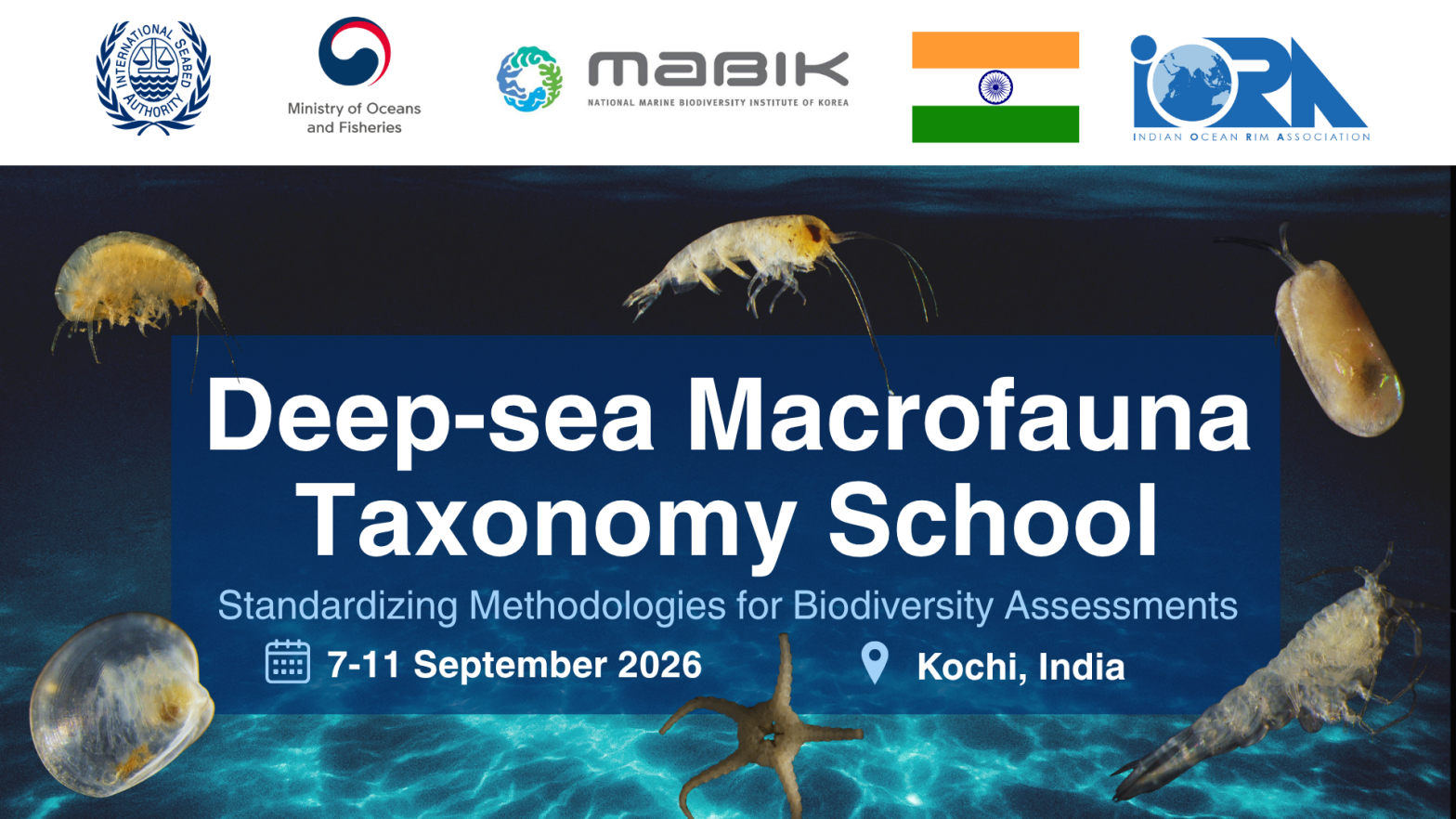
7 – 11 September 2026 | Centre for Marine Living Resources & Ecology (CMLRE), Ministry of Earth Sciences, Kochi, India
The International Seabed Authority (ISA), in collaboration with the Centre for Marine Living Resources & Ecology (CMLRE), Ministry of Earth Sciences (MoES), Government of India, the Indian Ocean Rim Association (IORA), and the National Marine Biodiversity Institute of Korea (MABIK), Ministry of Oceans and Fisheries of the Republic of Korea is pleased to announce the upcoming workshop on deep-sea macrofauna taxonomy standardization. This training workshop represents a unique opportunity to advance the knowledge and skills in the sampling, identification, and curation of deep-sea macrofauna.
Background
In accordance with the United Nations Convention on the Law of the Sea (UNCLOS), ISA is mandated to ensure the effective protection of the marine environment from potential harmful effects arising from seabed activities. A critical component of this mandate is the promotion of marine scientific research and the coordination of taxonomic knowledge to ensure activities in the international seabed area (the Area) are environmentally responsible.
Macrofauna, organisms larger than 250–300 μm, play a fundamental role in deep-sea ecosystems, contributing to organic matter processing, sediment mixing (bioturbation), and nutrient cycling. By standardizing taxonomic methods, ISA aims to bridge gaps in understanding deep-sea biodiversity and enhance the capacity of its developing Member States to conduct robust environmental assessments.
Workshop Objectives
The workshop programme facilitates a comprehensive understanding of macrofauna diversity and its ecological significance through several key areas:
- ISA Standardized Approaches: Training in standardized study methods for environmental baseline and monitoring studies.
- Taxonomic Identification: Capacity building in identifying and describing major taxa, including Annelida, Arthropoda, and Mollusca.
- Integrative Tools: Hands-on training in advanced techniques such as DNA barcoding, scanning electron microscopy, and biodiversity data analysis.
- Sample Curation: Best practices for sample preservation, labelling, and publishing data in open-access databases.
- Global Networking: Creating a network of deep-sea macrofauna taxonomists and promoting international collaboration.
Workshop Format & Outputs
The workshop will last 5 days, comprising a mix of lectures, field trips for practical sampling, and intensive laboratory sessions. Attendees will receive:
- A Macrofauna “Training Kit” featuring digital materials for identification and data sharing.
- Hands-on experience with macrofauna extraction and molecular methods.
- Opportunities for establishing post-workshop interactions and sustained collaborations as well as opportunities for becoming new trainers to convene future training schools in their countries.
Further details can be found in the workshop Terms of Reference. The programme will be sent at a later date to the selected participants.
Registration and Selection
Members of ISA, as well as observers, contractors, international and regional organizations, projects/programmes and initiatives, and academic/scientific institutions, from countries in the Indian Ocean region, are invited to register here, as soon as possible, but no later than 19 July 2026.
The maximum number of participants will be limited to 20 to enable effective engagement and training. Participants will be selected based on their experience in macrofauna diversity studies as well as their interest in collaboration in deep-sea macrofauna research and taxonomy. Geographic representation and gender balance will be taken into consideration. Selected participants will be notified by 27 July 2026.
Funding will be available by the organizers to support travel, accommodation, meals, and workshop materials for the selected participants.
Eligibility Criteria
- Nationality: Must be a national of a developing State member of ISA from the Indian Ocean Region
- Education: Minimum of a Bachelor’s degree in natural sciences and currently enrolled in a Master’s or PhD program in marine biology, ecology, or a related field.
- Language: Proficient in English (written and oral).
- Interest: Demonstrated motivation in investigating deep-sea macrofauna in the context of anthropogenic impact assessment.
- Experience: background knowledge in benthic fauna and/or taxonomy is recommended but not mandatory.
How to Apply
Interested candidates should prepare the following:
- Updated CV.
- Motivation Letter explaining your interest in macrofauna research.
- Proof of Education: Certificates of degrees and proof of current enrolment.
- Reference Letter (optional but recommended).
Application Deadline: 19 July 2026.
For enquiries, please contact: sski@isa.org.jm.